Rayleigh-Jeans Model
A handwritten note on standing electromagnetic waves and the Rayleigh-Jeans model.
Transcript
Page 1
We are in 20th century, and we have two Jewels of classical physics on our desk; Maxwell's electromagnetism (1865) and statistical mechanics (Boltzmann & Maxwell). Light is a continuous electromagnetic wave that travels at the speed of c, and heat is just the random motion of atoms.
There is also Gustav Kirschoff saying something about glowing objects all having the same universal function of T which I interpret as material indifference of glowiness metric.
Rayleigh then started asking some questions. If material doesn't matter I choose a hollow box with perfectly conducting surfaces inside. How many standing EM waves can fit inside this volume V = L³? How much heat does each standing wave get at temperature T?
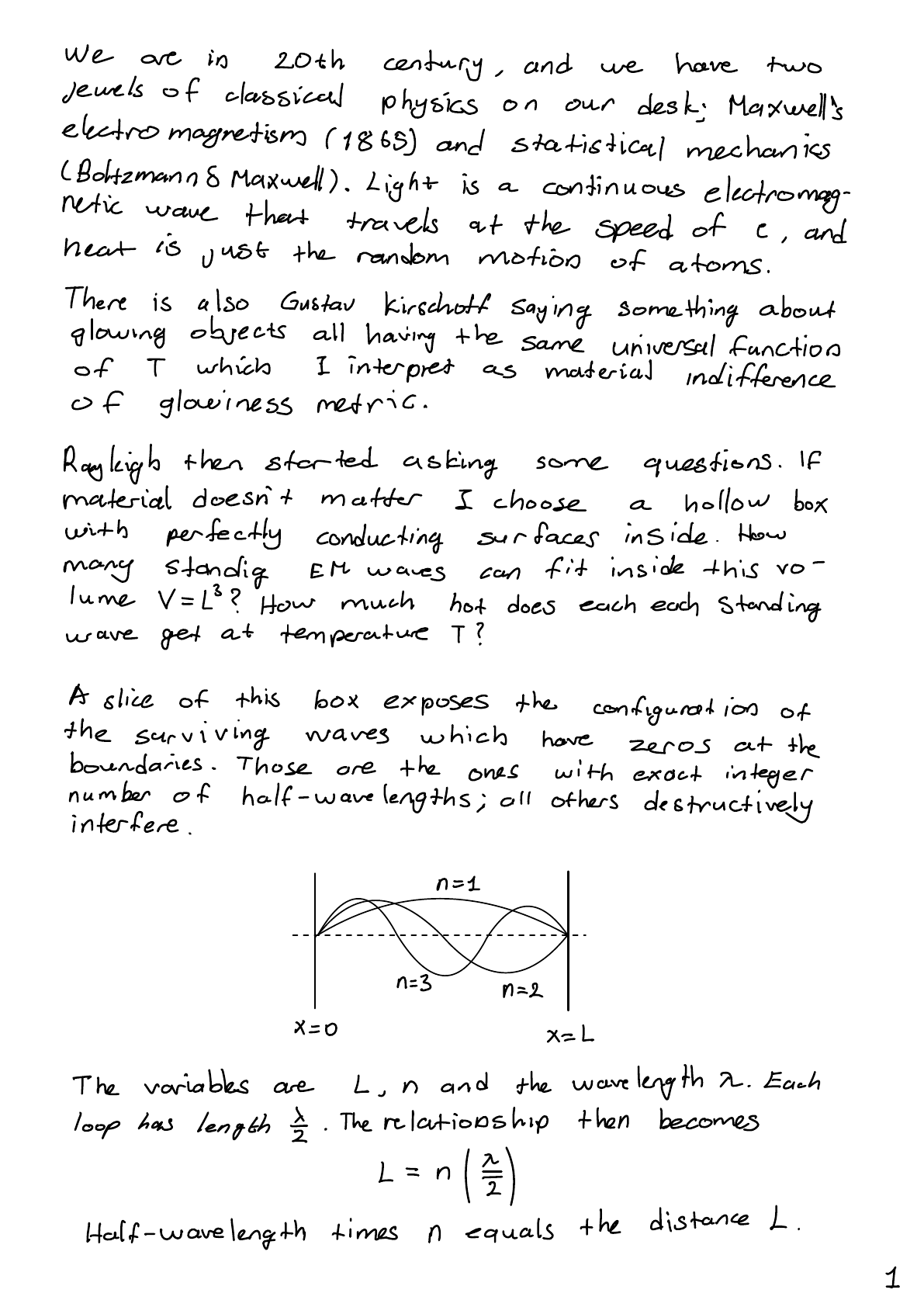
A slice of this box exposes the configuration of the surviving waves which have zeros at the boundaries. Those are the ones with exact integer number of half-wavelengths; all others destructively interfere.
[Figure: three standing waves labelled n = 1, n = 2 and n = 3 between two walls at x = 0 and x = L, each with zeros at both walls.]
The variables are L, n and the wavelength λ. Each loop has length λ/2. The relationship then becomes
L = n(λ/2)
Half-wavelength times n equals the distance L.
Page 2
Solve it for n
n = 2L/λ
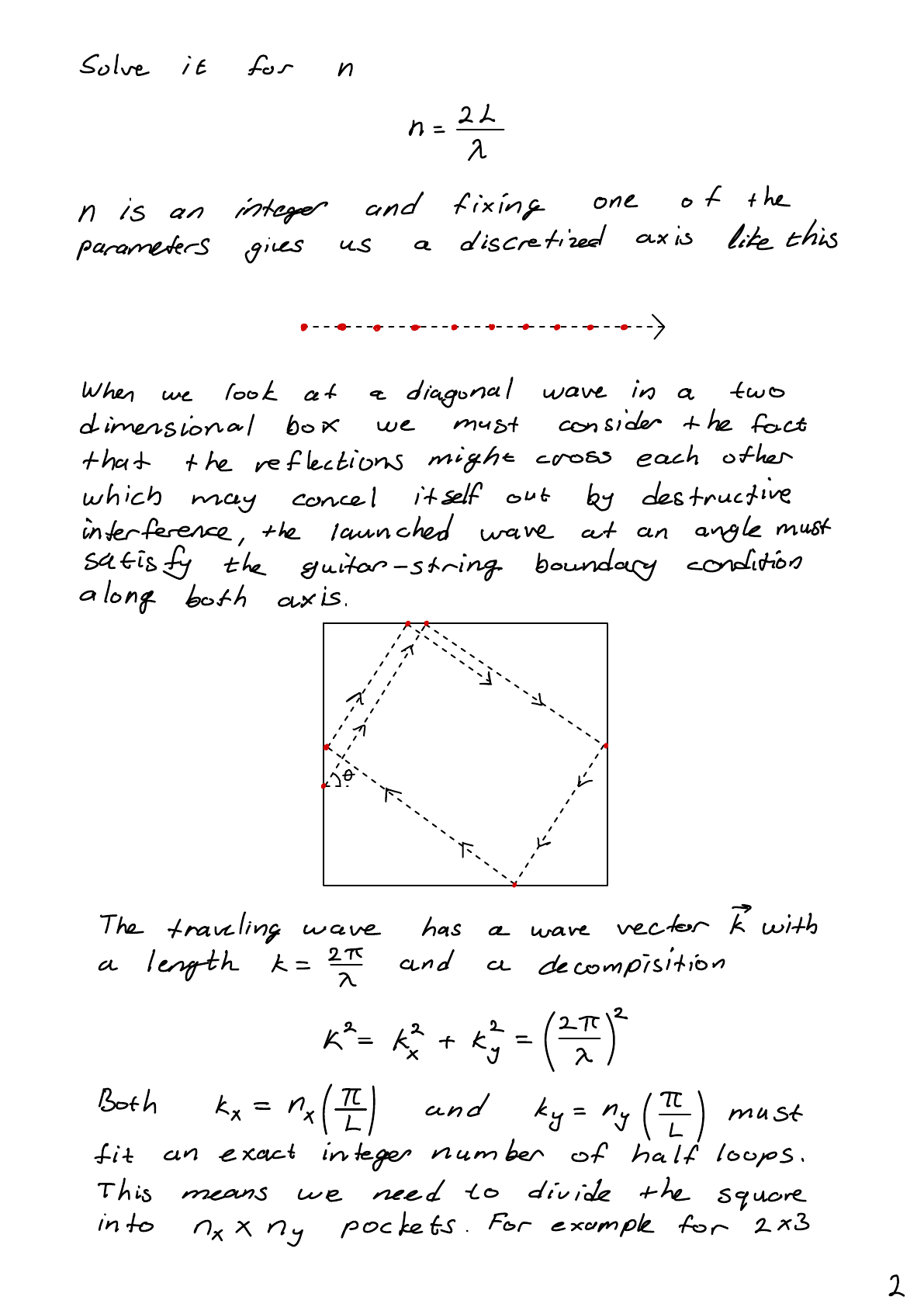
n is an integer and fixing one of the parameters gives us a discretized axis like this
[Figure: a dashed arrow with evenly spaced red dots marking the allowed integer values.]
When we look at a diagonal wave in a two dimensional box we must consider the fact that the reflections might cross each other which may cancel itself out by destructive interference, the launched wave at an angle must satisfy the guitar-string boundary condition along both axis.
[Figure: a square box with a dashed wave path launched from the left wall at angle θ, reflecting off all four walls, with the reflection points marked in red.]
The traveling wave has a wave vector k⃗ with a length k = 2π/λ and a decompisition
k² = k_x² + k_y² = (2π/λ)²
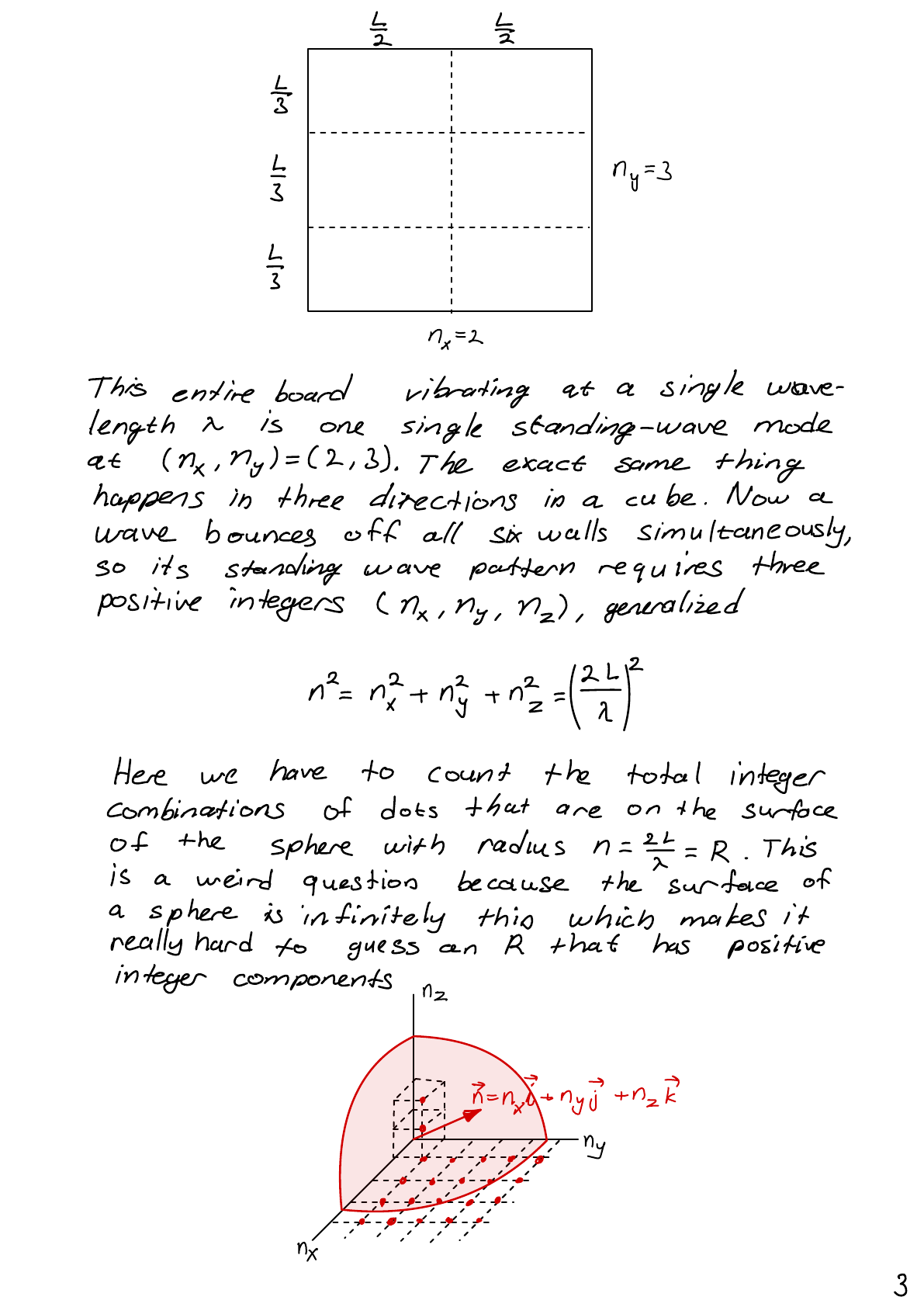
Both k_x = n_x(π/L) and k_y = n_y(π/L) must fit an exact integer number of half loops. This means we need to divide the square into n_x × n_y pockets. For example for 2×3
Page 3
[Figure: a square divided by dashed lines into 2 columns of width L/2 and 3 rows of height L/3, labelled n_x = 2 and n_y = 3.]
This entire board vibrating at a single wavelength λ is one single standing-wave mode at (n_x, n_y) = (2, 3). The exact same thing happens in three directions in a cube. Now a wave bounces off all six walls simultaneously, so its standing wave pattern requires three positive integers (n_x, n_y, n_z), generalized
n² = n_x² + n_y² + n_z² = (2L/λ)²
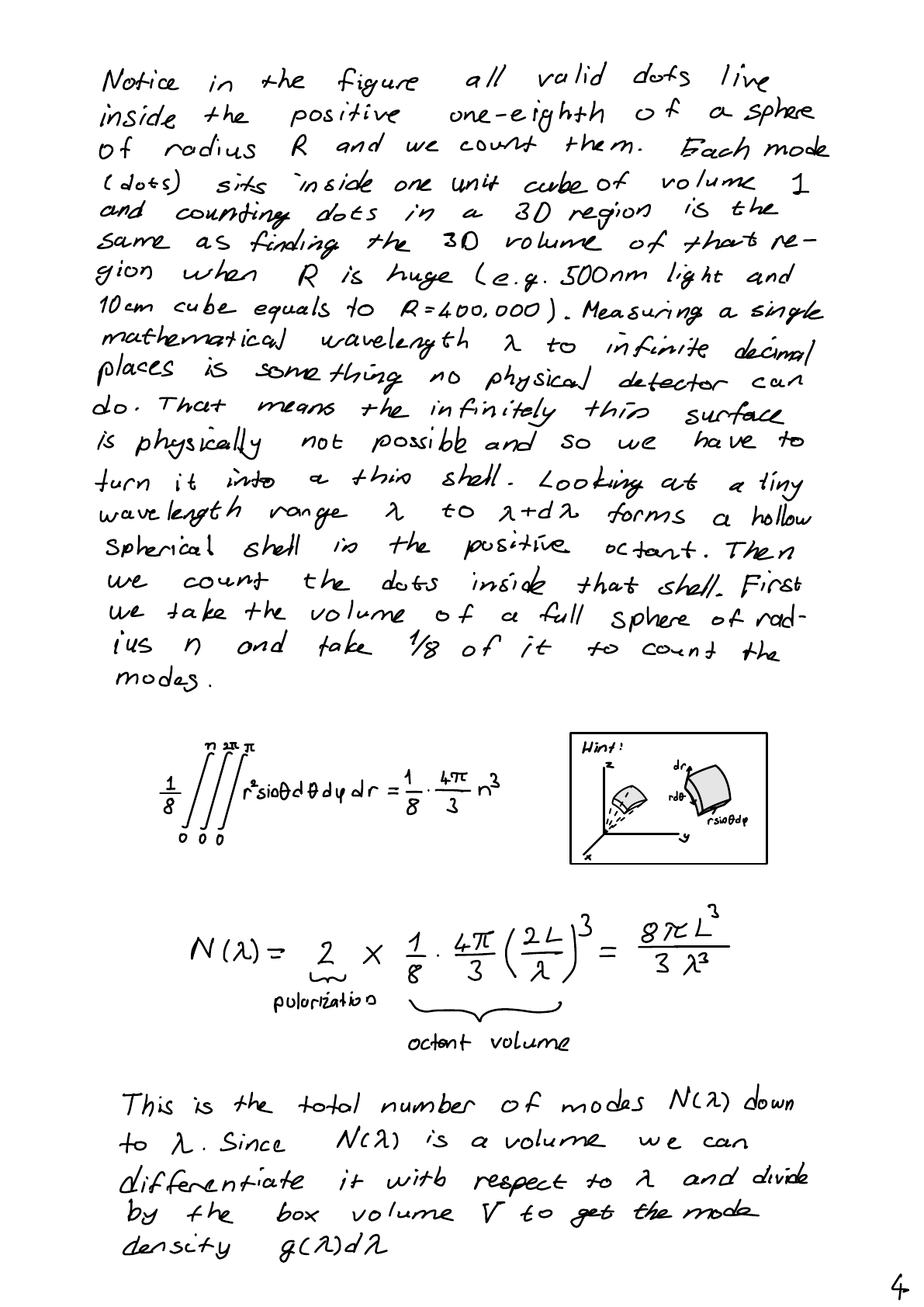
Here we have to count the total integer combinations of dots that are on the surface of the sphere with radius n = 2L/λ = R. This is a weird question because the surface of a sphere is infinitely thin which makes it really hard to guess an R that has positive integer components
[Figure: the positive octant of a sphere on axes n_x, n_y, n_z, filled with a lattice of red integer points and a vector n⃗ = n_x i⃗ + n_y j⃗ + n_z k⃗ pointing to one of them.]
Page 4
Notice in the figure all valid dots live inside the positive one-eighth of a sphere of radius R and we count them. Each mode (dots) sits inside one unit cube of volume 1 and counting dots in a 3D region is the same as finding the 3D volume of that region when R is huge (e.g. 500nm light and 10cm cube equals to R = 400,000). Measuring a single mathematical wavelength λ to infinite decimal places is something no physical detector can do. That means the infinitely thin surface is physically not possible and so we have to turn it into a thin shell. Looking at a tiny wavelength range λ to λ + dλ forms a hollow spherical shell in the positive octant. Then we count the dots inside that shell. First we take the volume of a full sphere of radius n and take 1/8 of it to count the modes.
(1/8) ∫₀ⁿ ∫₀^2π ∫₀^π r² sinθ dθ dφ dr = (1/8) · (4π/3) n³
[Figure: a "Hint!" box showing a spherical volume element on x, y, z axes with sides dr, r dθ and r sinθ dφ.]
N(λ) = 2 × (1/8) · (4π/3) (2L/λ)³ = 8πL³ / (3λ³)
[The factor 2 is labelled "polarization" and the term (1/8) · (4π/3) (2L/λ)³ is labelled "octant volume".]
This is the total number of modes N(λ) down to λ. Since N(λ) is a volume we can differentiate it with respect to λ and divide by the box volume V to get the mode density g(λ)dλ
Page 5
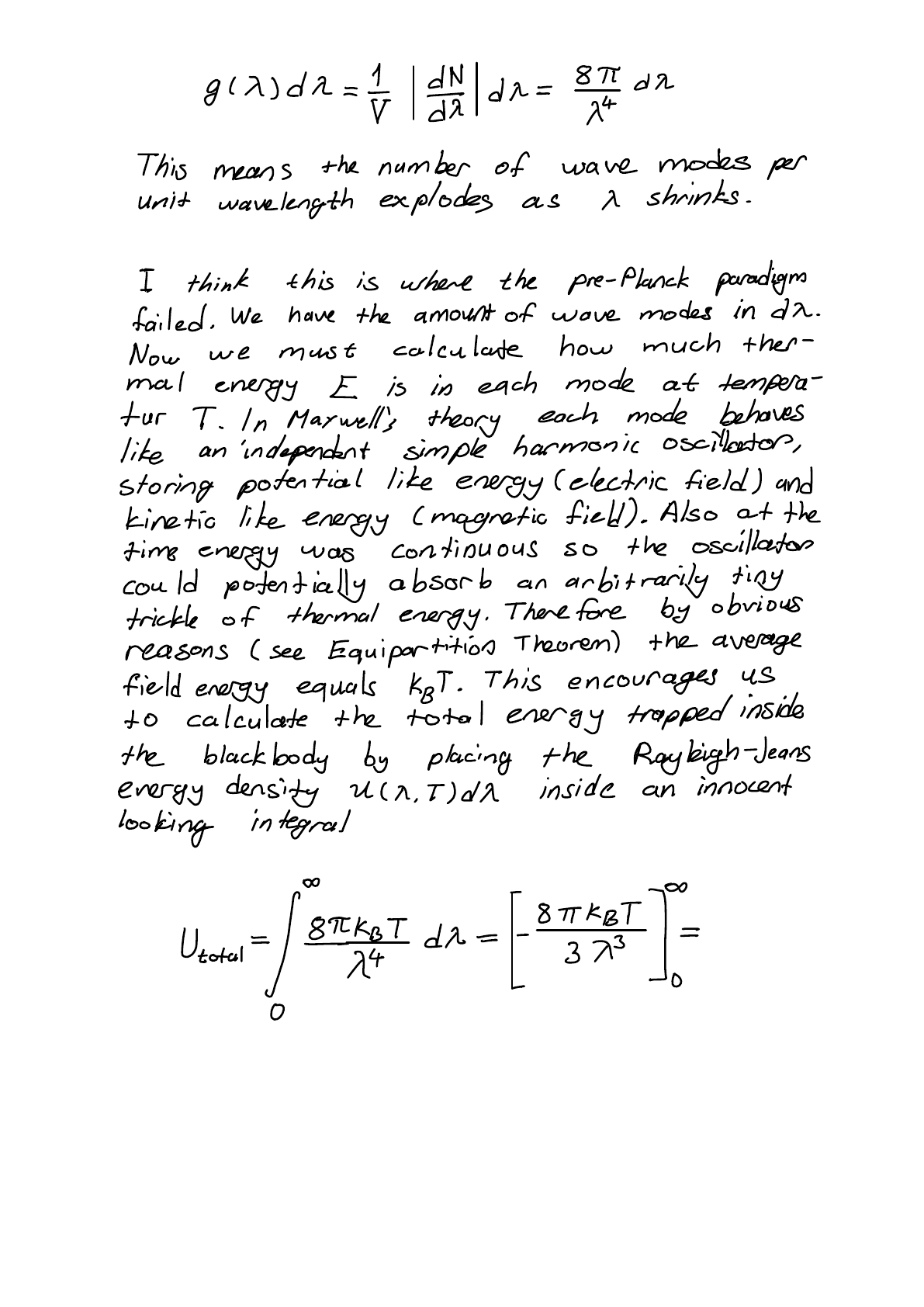
g(λ)dλ = (1/V) |dN/dλ| dλ = (8π/λ⁴) dλ
This means the number of wave modes per unit wavelength explodes as λ shrinks.
I think this is where the pre-Planck paradigm failed. We have the amount of wave modes in dλ. Now we must calculate how much thermal energy E is in each mode at temperature T. In Maxwell's theory each mode behaves like an 'independent simple harmonic oscillator', storing potential like energy (electric field) and kinetic like energy (magnetic field). Also at the time energy was continuous so the oscillator could potentially absorb an arbitrarily tiny trickle of thermal energy. Therefore by obvious reasons (see Equipartition Theorem) the average field energy equals k_B T. This encourages us to calculate the total energy trapped inside the blackbody by placing the Rayleigh-Jeans energy density u(λ, T)dλ inside an innocent looking integral
U_total = ∫₀^∞ (8πk_B T / λ⁴) dλ = [ −8πk_B T / (3λ³) ]₀^∞ =